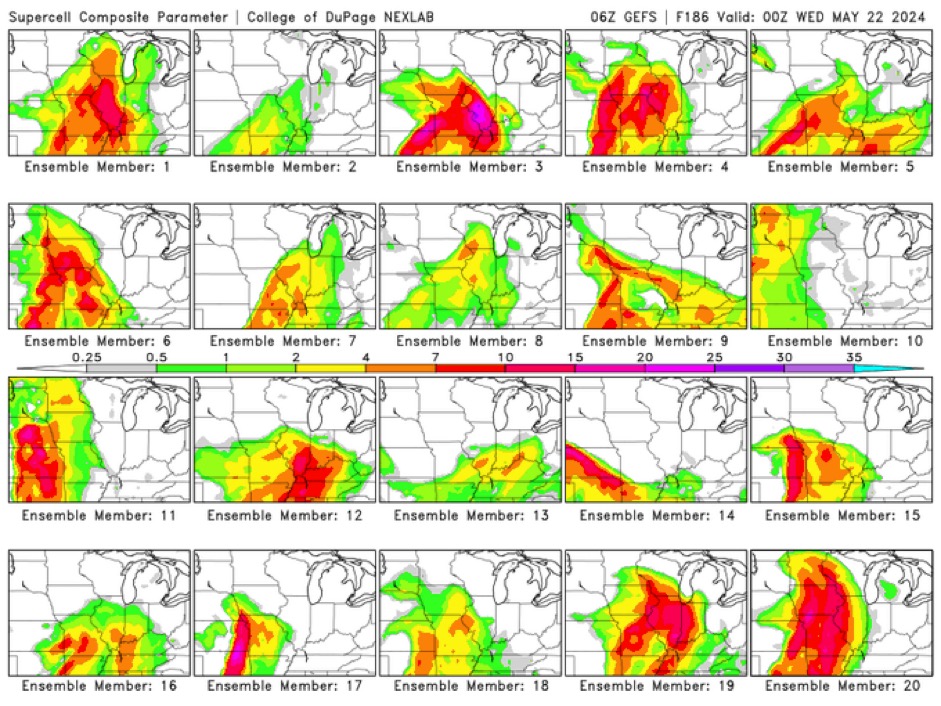
While scrolling through Weather Twitter, I saw this ensemble map posted by a Storm Chaser. I looked at all the colors and decided that I was looking at a forecasted time lapse of the next few days showing that we’re going to be having some severe weather here in Illinois. The poster of this model captioned it with something along the lines of “The last 10 days of May are looking interesting,” so I knew I had to dig in and see what it meant.
For anyone interested, you can find a similar model here: https://weather.cod.edu/forecast/ and I’ll show you the settings I used to get this exact time frame
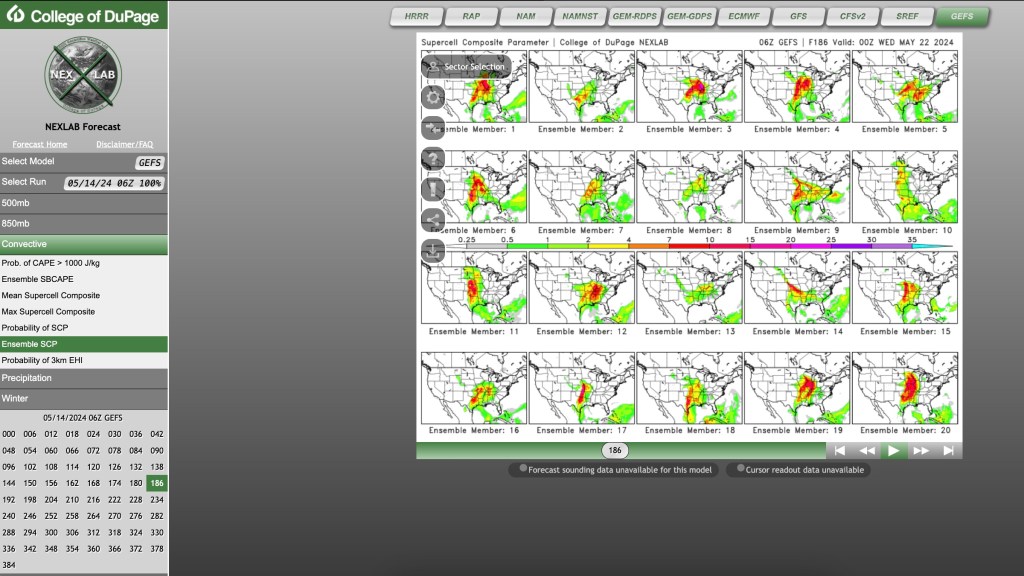
Let’s start with the type of model we are looking at. In weather and forecasting, there are, by my estimate, a bajillion different models that can be used to interpret weather data. They’re each titled with a fun acronym (sarcasm, acronyms are NOT fun), and point to different types of data. This particular model is called the GEFS, or Global Ensemble Forecast System which, according to the National Centers for Environmental Information, is a weather forecast model made up of 21 separate forecasts, or ensemble members. These forecasts are then combined, and the mean (or average) of the data creates the model. From that information, I gather that the Supercell Composite Parameter is showing each of the separate forecasts for a given day that will be combined and averaged into the outlook for that day.
Why so many forecasts? A forecasting model is only as accurate as the information that is fed into it, but there are variables that can slightly alter the outlook for a day. When creating a GEFS, the initial data is slightly altered in different ways to account for the variable accuracy of the initial data.
You may be wondering: With 21 different possible forecasts, isn’t there a lot of room for error? The point of combining and averaging the forecasts into 1 is that each individual forecasts accounts for different uncertainties. I think of it like this: If I were planning a trip somewhere that I had never been before during a transitional time of year (spring or fall), I could pack my suitcase with a rain coat, a winter coat, a sweat shirt, a long-sleeve shirt, a t-shirt, pants, shorts, etc. or I could find clothing items that account for multiple conditions such as a rain jacket with a removable fleece insert, those super stylish hiking pants that zip off into shorts, etc. and that would be an efficient solution that covers all of my bases.
Okay, so back to the forecast: What does it mean? Well, considering this forecast is the ensemble of potential forecasts for 8 days from now, it means little (in my opinion). Sure, there’s a decent chance that we’ll see some severe weather here in Illinois but it’s too far out to tell. In my desire to chase storms, I am learning that banking on a forecasted severe weather day is a good way to let yourself down.
Here’s an incredible source I found to help me interpret and learn more about the GEFS model: Penn State Fundementals of Meteorology: 5b. More On Ensemble Forecasting
 Strange Clouds WX
Leave a comment